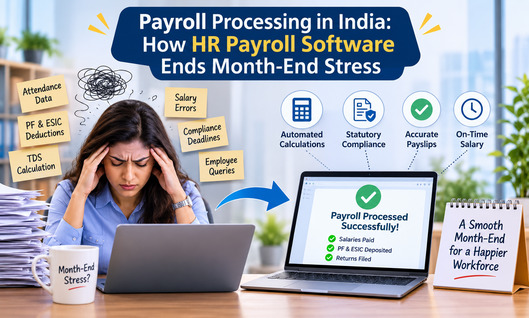
Every month, HR teams across India run the same race: collect attendance, calculate salaries, deduct PF, ESIC and TDS, pay on time and file returns without a single mistake. At SGCMS (SGC Management Services Pvt. Ltd.), we see how one small slip can delay salaries, trigger employee complaints or invite a compliance notice. Accurate payroll processing protects employee trust and keeps your business compliant. This guide shows where things usually go wrong and how to fix them.
In Short: Payroll is the monthly cycle of collecting attendance, calculating pay, applying statutory deductions, paying employees and filing returns. Software automates the calculation. A system that also links attendance, leave and employee records removes the data mismatches behind most errors.
Why Month-End Goes Wrong
Most payroll errors are not maths errors. They are timing and data errors:
- Attendance reaches HR after the cut-off, so salaries are recalculated.
- A new joiner’s UAN, bank account or PAN is missing.
- A spreadsheet formula breaks in one cell and the mistake repeats across every payslip.
- PF, ESIC or professional tax rules change, but the old template stays in use.
- Only one person understands the process, and that person goes on leave.
If two or more of these sound familiar, your salary cycle depends on individual effort instead of a reliable system.
Six Steps From Cut-Off to Compliance
Here is the payroll process every Indian employer follows, whether the team is five people or five thousand:
- Freeze inputs. Set a firm cut-off for attendance, leave, overtime, reimbursements, joiners and exits.
- Verify employee data. Check bank details, UAN, ESIC number, PAN and salary structure.
- Calculate gross pay. Apply earnings, allowances, incentives, arrears and loss-of-pay days.
- Apply deductions. Work out PF, ESIC, professional tax, labour welfare fund (where applicable) and TDS on salary.
- Review and approve. Compare with last month and investigate unusual variances before release.
- Pay, deposit and file. Credit salaries, share payslips, deposit statutory dues and file returns before their due dates.
A practical rule: finish steps 1 to 5 before the last week of the month, so salary day is only about release, not repair.
How Software Removes Repetitive Work
Good payroll software handles the rule-based parts of the cycle automatically:
- Salary structures defined once and reused every month
- Automatic calculation of PF, ESIC, professional tax and TDS
- Bulk payslip generation and bank transfer files
- Statutory reports ready for filing
- Fewer manual entries, which means fewer errors
It suits businesses with a stable workforce whose attendance and employee records are already well managed.
Why HR Payroll Software Goes One Step Further
Standalone tools calculate pay. HR payroll software connects pay with the HR data that feeds it: employee master records, attendance, leave, onboarding, exits and employee self-service. When HR approves a leave or adds a joiner, the salary side sees it immediately. Nobody types the same information twice, and attendance and pay no longer disagree.
| Capability | Basic software | Integrated system |
|---|---|---|
| Salary and deduction calculation | Yes | Yes |
| Statutory reports | Yes | Yes |
| Attendance and leave link | Limited | Built in |
| Employee self-service | Sometimes | Usually |
| Joiner and exit records | No | Yes |
| Best for | Small, stable teams | Growing, multi-location teams |
How to Choose the Right Solution
Before you commit, ask:
- Compliance: Does it cover every Indian statutory component, and who updates it when rules change?
- Flexibility: Can it handle your most complicated employee, not just the simplest?
- Attendance link: Does it connect to biometric or mobile attendance?
- Security: Look for role-based access, encryption, backups and audit logs.
- Support: Who helps you at month-end, and how fast?
- Total cost: Compare licence, setup, add-ons and renewal terms.
Always request a parallel run using one month of your own data. Any difference between old and new results shows either an error in your current method or a gap in the new tool.
When Your Team Needs Expert Support
Software calculates what you give it. It cannot fix a late attendance file, an unclear policy or a missed approval. If your HR team is stretched, a managed payroll process run by specialists can handle calculations, deposits and filings while you keep control of approvals and salary decisions.
Conclusion: Build a Month-End You Can Trust
Reliable payroll processing means fewer errors, fewer surprises and a team that is not working late on salary day. SGCMS helps businesses across India simplify payroll and compliance. Visit our home page to explore our services, or contact us to discuss your payroll needs.
Frequently Asked Questions
What is payroll software? It is a system that automates salary calculation, statutory deductions, payslips and reports, so employers can pay accurately and on time.
What is the difference between basic and integrated payroll tools? Basic tools focus on pay calculation and reports. Integrated systems also manage attendance, leave and employee records in one place.
Is an integrated system worth it for a small business? Yes, if you have shifts, frequent joiners and exits or more than one location. A very small, stable team may manage with a simpler tool.
Can software handle PF, ESIC and TDS? Good systems automate these calculations and reports, but you still need correct inputs and timely deposits.
How long does implementation take? It depends on data quality, but plan for at least one parallel cycle before going live.