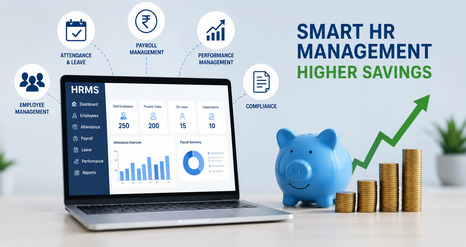
In today’s competitive business environment, companies are constantly looking for ways to reduce operational costs, improve employee productivity, and streamline administrative processes. One of the most effective solutions helping organizations achieve these goals is Human Resource Management System (HRMS) software.
Many businesses initially view HRMS software as a tool for managing employee records and attendance. However, the reality is much broader. A well-implemented HRMS can help companies save lakhs of rupees every year by reducing manual work, minimizing errors, improving compliance, and enhancing workforce efficiency.
At SGC Management Services Pvt. Ltd., we have observed how businesses across various industries benefit financially and operationally after adopting modern HRMS solutions. This article explores the key ways HRMS software helps organizations achieve significant cost savings while improving overall HR performance.
Understanding HRMS Software
HRMS (Human Resource Management System) is a digital platform designed to automate and manage various HR functions, including:
- Employee information management
- Attendance and leave tracking
- Payroll processing
- Recruitment and onboarding
- Performance management
- Compliance monitoring
- Employee self-service portals
- Training and development management
By integrating these functions into a single system, organizations can eliminate repetitive administrative tasks and improve decision-making through real-time data insights.
1. Reduced Administrative Costs
One of the biggest areas where companies save money is administrative efficiency.
Traditional HR processes often involve:
- Paper-based documentation
- Manual attendance records
- Spreadsheet-driven payroll calculations
- Physical employee files
- Time-consuming reporting
HRMS software automates routine tasks, allowing HR teams to focus on strategic initiatives rather than repetitive administrative work. As a result, companies can reduce operational expenses and utilize HR resources more effectively.
2. Payroll Error Reduction
Payroll mistakes can be expensive.
Manual payroll processing frequently leads to:
- Incorrect salary calculations
- Tax deduction errors
- Overtime miscalculations
- Leave adjustment mistakes
- Delayed salary payments
HRMS software automates payroll calculations based on attendance, leave balances, tax rules, and statutory requirements. This significantly reduces errors and ensures accurate salary processing every month.
3. Better Attendance and Leave Management
Employee attendance directly impacts productivity and labor costs.
Manual attendance systems often create challenges such as:
- Buddy punching
- Inaccurate time records
- Attendance manipulation
- Delayed reporting
Modern HRMS solutions integrate with biometric systems, mobile attendance apps, and geo-location tracking to provide accurate workforce data.
Managers gain real-time visibility into employee attendance, overtime, and leave balances, enabling better workforce planning.
4. Lower Recruitment Expenses
Hiring the right talent is critical, but recruitment can be expensive when managed inefficiently.
Without HRMS software, recruiters often spend excessive time on:
- Resume screening
- Candidate tracking
- Interview scheduling
- Communication management
- Documentation
An HRMS with recruitment automation streamlines the entire hiring process.
Features such as Applicant Tracking Systems (ATS), automated communication, and centralized candidate databases help recruiters fill positions faster and more efficiently.
5. Improved Employee Retention
Employee turnover is one of the hidden costs many organizations underestimate.
Replacing an employee involves:
- Recruitment expenses
- Training costs
- Productivity loss
- Knowledge transfer delays
HRMS software helps improve employee engagement through:
- Self-service portals
- Performance tracking
- Recognition systems
- Learning and development programs
- Transparent communication
Employees who feel supported and valued are more likely to stay with the organization.
6. Enhanced Compliance Management
Labor laws, tax regulations, and statutory compliance requirements continue to evolve.
Failure to comply can result in:
- Financial penalties
- Legal disputes
- Reputational damage
- Operational disruptions
HRMS software helps businesses maintain compliance by automating:
- PF calculations
- ESI contributions
- TDS deductions
- Statutory reporting
- Employee record maintenance
Automated alerts and compliance tracking reduce the risk of missed deadlines and regulatory violations.
7. Data-Driven Decision Making
Many companies lose money because they lack visibility into workforce trends.
HRMS software provides valuable analytics related to:
- Employee productivity
- Attendance patterns
- Attrition rates
- Recruitment performance
- Training effectiveness
Business leaders can use these insights to make informed decisions and optimize workforce planning.
8. Increased Employee Productivity
Employees often waste time handling administrative HR tasks such as:
- Applying for leave
- Downloading salary slips
- Updating personal information
- Checking attendance records
HRMS self-service portals allow employees to complete these activities independently.
This reduces HR workload while enabling employees to focus more on their core responsibilities.
9. Reduced Paperwork and Storage Costs
Paper-based HR operations generate recurring expenses related to:
- Printing
- Filing
- Storage
- Document retrieval
- Record maintenance
Digital HRMS platforms securely store employee data in a centralized location, eliminating the need for extensive physical documentation.
10. Scalability Without Increasing HR Costs
As companies grow, managing employees manually becomes increasingly difficult.
Without automation, organizations often need additional HR staff to handle growing administrative demands.
HRMS software allows businesses to scale operations efficiently without proportionally increasing HR headcount.
Real Business Value Beyond Cost Savings
While financial savings are a major advantage, HRMS software also delivers long-term business benefits:
- Improved employee experience
- Faster HR processes
- Better workforce visibility
- Stronger compliance management
- Enhanced organizational efficiency
- Improved decision-making capabilities
Conclusion
Implementing HRMS software is no longer just a technology upgrade—it is a strategic business investment. From reducing administrative expenses and payroll errors to improving compliance and employee retention, HRMS solutions help companies save lakhs of rupees every year while enhancing overall organizational performance.
Businesses that continue relying on manual HR processes often face hidden costs, inefficiencies, and compliance risks that impact long-term growth. By adopting a modern HRMS solution, organizations can streamline operations, improve workforce management, and create a more productive workplace.
At SGC Management Services Pvt. Ltd., we understand the evolving HR challenges businesses face and the importance of leveraging technology to build efficient, compliant, and cost-effective HR operations. Investing in the right HRMS solution today can create measurable financial and operational benefits for years to come.